
It isn’t often I post about recent work (every few years actually). Mostly I’m no longer actively looking for new business but I felt I should do a boast post this time!😄
We have been privileged to have developed a few websites for The Travelling Pig. The Travelling Pig are superb Event Caterers based in the heart of the Pennines. They cover much further than you might imagine – to Northern Ireland, Scotland, Wales and to Southern England! Their work ethic is great, delivering top quality catering for weddings, corporate events and private functions and cover all their guests dietary needs. Bringing a smile to their customer’s face and relieving them of any catering stress is what they really love about their work.
Our role
Since redeveloping their website in 2012 we have gone with them on their journey. Initially we got them off the ground outside of their local area with pay per click advertising but eventually we were able to build their organic search so well that the pay per click was no longer needed.
Much of that work was about SEO where we could see that leveraging their wide base of excellent reviews would pay dividends and it has. Of course this is because The Travelling Pig do an amazing job with a 4.9 out of 5 rating!

Google and more to digest that you can EEAT?
During 2025 and again at the start of 2026, they noticed a drop off in enquiries. After some investigations, Google’s rollout of their E-E-A-T framework was found to be the issue. E-E-A-T stands for Experience, Expertise, Authoritativeness, and Trustworthiness. It isn’t a direct search ranking factor as such but it’s principles are written into their algorithms to identify helpful, reliable, people-first content. On the face of it you can’t argue with that and it should result in a better webpage visiting experience.
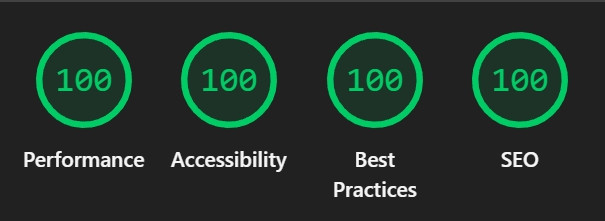
Google Lighthouse score – all 100s!
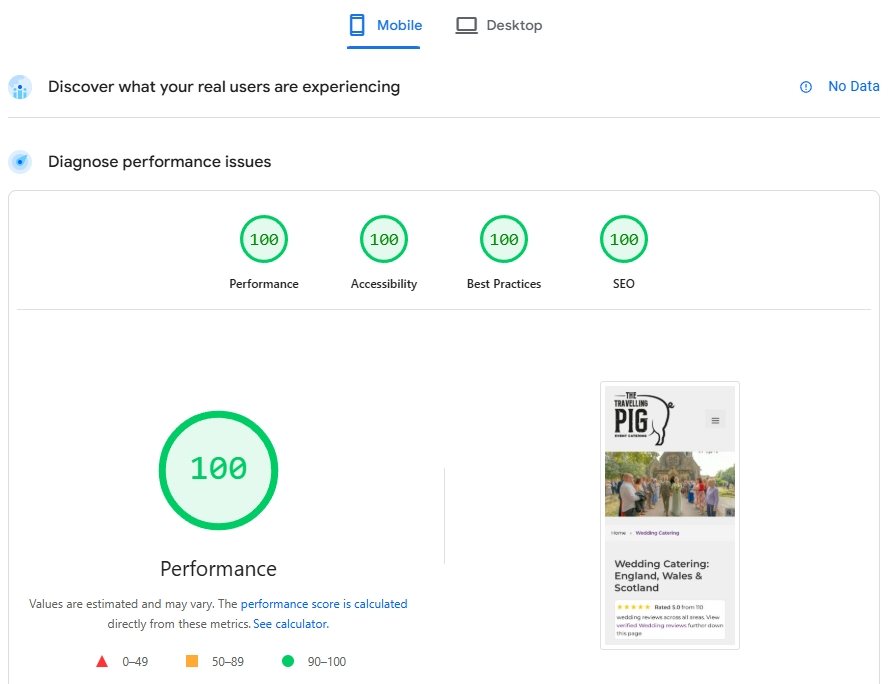
Google provide various tools to help spot issues, such as Lighthouse which is about responsive performance, layout shifts, download efficiency, accessibility and SEO. It gives a score ot of 100 for a webpage on these factors and a good website would hope to get to the high 80s, early 90s. Giving our client’s our best shot resulted in all four hitting 100 on most of their website!
Super-efficient programming
This did take a lot of blood, sweat and tears to do! Their website isn’t simple. All pages have full schemas to squeeze best value out of targetted use of their reviews. Review stats are compiled overnight as is other dynamic information to eliminate unnecessary slow downs in download time. Functions code is slimmed down to include other sections only when relevant to that particular page.
Years ago when computer processors and memory was hugely expensive, I had a real telling off by my senior programmer for declaring an array of 10000 on-off switches as bytes (eight bits per byte). I should have just used one bit per array element which would be far more efficient and so I rewrote the program to do that. The experience stayed with me and it is good to see that Google gives some rewards through these scores for that.
All too often we see nice looking engaging websites which are so slow because the web developer has little experience of efficient programming techniques. The result of course is a bloated website that is penalised by Google for speed and clicked away from by visitors for the same reason.
We also make good use of server caching with Litespeed and Redis Object caching. Both can be difficult to get right but worth the fight!
Counter-intuitive perhaps
In the good old days, not so long ago, blackhat SEO involved keyword stuffing eg. repeating a keyword on a web page like a mantra so that Google etc would think “this page is really relevant for keyword“. Often keyword’s would be in a large font in white on a white background too!
Keywords
You didn’t have to go that far without the importance of repeating keywords being almost tattooed on the inside of your eyelids for web developers and SEO engineers! So EEAT is really where Google has grown-up and realised it is more about the page visitor’s experience.
Less can be more
Sometimes less is more when it comes to page indexing. Google rations how much time it spends indexing a website. If you tell it “I change every one of these 500 pages every day” it might as well reply with “good for you but I’m only going to bother looking at 15 a day”. It has a budget and by asking too much you will actually get less!
The temptation to tell Google to index everything can dilute its focus and result in nothing much. So we actually took the step of removing 80% of the pages from the sitemaps to better manage the promotion with Google indexing.